 |
| Jean-François Millet Mademoiselle Henriette Ferre, 1841 |
“She looks very French,” opined an astute voice from behind me during the opening reception of the Mississippi Museum of Art’s new exhibit Old Masters to Monet: Three Centuries of French Painting. We were both looking at Jean-François Millet’s Mademoiselle Henriette Ferre, an exemplary work of Millet’s portraiture (and one in which I came back to quite a few times over the next two days) that pictures a jeune femme with black hair, down-turned sallow face in three-fourths, almost pouting for how long she is having to stand for the master of Realism. It may not have been the most thoughtful assessment from the gentleman behind me, but he did strike a chord about the exhibit: it is very French. Or, at least our idea of what French art should be.
 |
| Jean-Baptiste Greuze Indolence "La Paresseuse Italienne" 1757 |
The exhibit promotes fifty brilliant displays of what we can
always look at and say “yes, that’s definitely French art.” All the greats are
on hand, many of the later, well-recognized 19th century artists
being noted on the advertisements, but beautiful works by Ingres, Lorraine,
Courbet, Chardin, Redon, and Greuze surprise the viewer as they walk along, while an unfortunately conserved Poussin inaugurates the question of “What once was this?”.
That question permeates through the entire exhibit, as
three-hundred years of French art is encapsulated and the great transitions of
style are seamlessly blended. Where the story succeeds in telling French art
from Baroque and Rococo to Impressionism and its Post-Imp artists, it also
fails in allowing any deviation from a generic survey. There is a Redon, but
where is the story of the Symbolists? The Millet, while grand, nearly glosses
over the impact that the artists of Barbizon had on French en plein air and their impressionist successors, and this same loss
is felt when the influence of japonisme and
shifts in art during the era of Napoleon are left as mere gestures.
It’s also false for the audience that leaving off at Monet implies
he was the point d’appui, his ever-beautiful
Nymphéas (water lilies) being the
last painting in the exhibit, for the future of French art after him. Cézanne’s
trees continually enchant, but his and Vuillard’s (not to mention Les Nabis) influence as primary
benefactors and their handling of color passed to artists of the 20th
century is entirely removed. This would be helpful for any 20th
century artists following the Impressionists, but it’s the tie-in of the Theora Hamblett exhibit that one immediately comes to upon exiting the blue-walled
French art that would greatly benefit from better direction.
 |
| Paul Cézanne, House and Trees |
 |
| Theora Hamblett The Day Angie Moved |
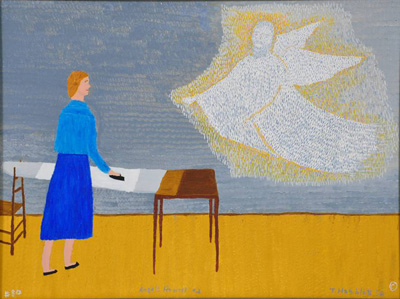
Like Cézanne, Hamblett is equally known for her formation
and painting of trees – the trees often controlling hers and Cézanne’s landscapes. I
first came to love and admire Hamblett’s work when working with the University of Mississippi Museum – where these 42 pieces originate from – and it’s again the
UM Museum’s work in this exhibit that made me see her in an entirely
new light. The three series of Hamblett’s work, Dreams and Visions, Old Home Memories, and Children’s Games are all equally well represented and show why
exactly this mostly self-taught artist deserves our due attention. No doubt
curated by Marti Funke of the UM Museum, Hamblett’s seriousness and intensity as a painter –
though her paintings are bright and cheerful – is well understood as she chose
to paint nearly everything that happened in her life. The drifts in perspective
and the naïve application of color are not something beholden to just quote
“folk” artists, but show Hamblett’s intuition in designing her scenes.
 |
| Henri-Edmond Cross San Giorgio Maggiore, Venice 1904 |
The only loss that is experienced is when the museums
attempt to relate both exhibits as a pas
de deux of Pointillism. Hamblett, while using dots and points to color her
trees with foliage, and less often painting on other flora, is not a pointillist. This is the biggest problem
when attempting to pair Hamblett with Pointillism, which in the graces of Seurat,
Cross, and Signac built and organized forms inspired by then-recently
published theories on color from Chevreul, Goethe, and others. Hamblett does not fail in
her application of dotted paint; it is the later attempts in trying to justify
her works as a part of the acceptable art historical canon that fails. Let
Hamblett remain as the seriously intuitive artist she was, because ‘folk’ art
no longer has to leave a bad taste in people’s mouths.
 |
| Theora Hamblett Angel's Request #2 |
Old Masters to Monet: Three Centuries of French Painting is on view until September 8th.
Symbols of Faith, Home, and Beyond: The Art of Theora Hamblett is on view until June 23rd.


No comments:
Post a Comment