Thursday, April 26, 2012

Guernica, today

Pablo Picasso "Guernica" courtesy of Museo Reina Sofia


                                                                 This night, now seventy-five years passed, the majority of people in the U.S. were learning from FM waves coming out of Paris, of a catastrophic bombing in the Basque mountains of Spain. Guernica, in Basque Guernika, had fallen victim to a practice run of Hitler's Luftwaffen - a tactic which would later be called the Blitzkrieg, all under Franco's consent. The painting above, Picasso's masterpiece, would be inspired by what he read in Le Journal the following morning. It would also be his first major statement in politics. The painting, afterwards, would become synonymous with war and its horrors, as well as influence international policy over the last century. 

             I've never quite understood my fascination with Guernica, even when finally confronting it last summer. Pleased to have finally seen it, even more so to hear one of my best friends - who considers himself distant from art - engrossed with the painting, I still couldn't understand why there was such a connection between it and myself. I don't have any ties to Spain, with the exception of a few friends who don't live anywhere near Basque country, and I've always felt Picasso's other works revel too much in his ego. That may be why I enjoy this political piece from him more (and I will always consider it my favorite painting), but when travelling through Bilbao by myself one day I started to reflect more on who the Basque people were, who these Euskadi were who still fight for their independence and identity today.

            Thinking about this idea of identity in relation to Picasso's masterpiece while walking back home tonight, after only buying a jar of the cheapest spaghetti sauce I could find for dinner, I immediately came upon some similarities between the Spaniard and his work. While he may have always retained his youthful prankster self, telling us that when he paints a horse he paints only a horse - leaving many to appropriate different symbols and spin urban myths - it's evident that he started to come into wisdom, instead of just smart ideas, after this painting for the upcoming world fair. With this wisdom, he added to the world something that supersedes diplomacy or propaganda, something with real life that screams at us through that wailing woman's up-turned head, her dagger tongue threateningly pleading us from committing future stupidity in relevance to the past at her costs. In that sense, it almost becomes religious. But to deter away from making art, and this post, religious or overly political, I wanted to highlight what is happening today: What are the modern day Guernicas, and how are these artists' identities portrayed through their art?


Ai Weiwei "Sunflower Seeds" at Mary Boone
          This may be typical of me as-of-late, but I have to start with China. Also, when I think of China, I can't get away from immediately thinking of Ai Weiwei, immediately followed by Cai Guo-Qiang. Call me ignorant to less popular Chinese artists, but there's a reason these two artists spring to mind so quickly: their art is truly revolutionary. I'm fascinated by the generation of Chinese who came of age during the Cultural Revolution, whose previous main idea of art was the mass-produced Mao standard portrait. Both Ai and Cai tie together historical influence in their work, the former for one instance appropriating the legendary Jingdezhen porcelain factory for his Turbine Hall installation Sunflower Seeds  - representing the dispensable worker in a field of millions, and Cai using firecrackers and gunpowder to literally ignite ideas that incorporate different epochal ideas, but with an eye to modernity. These two artists represent contemporary China to its fullest. 


Rendering of "Wreath" from Cai Guo-Qiang's Black Ceremony

          They also represent China's vast potential for working outside its borders. Even under house arrest from the Chinese government, Ai is again working with the architects Herzog & de Meuron to create the 12th summer pavilion for Serpentine Gallery - once again incorporating his fascination with communication. The team is aiming to coalesce, or bring together, the past eleven pavilions into one idea by digging down to each of the original foundations of the past works and forming something new while also revealing what is usually hidden in Kensington Gardens: the groundwater. Each artist wants to unearth what has been covered over by governments and institutions. The same is with Cai who, in his own medium, elaborately traced the connections of East and Middle East for his exhibition Saraab earlier this year in Qatar - highlighting the relations and unions between the different regions, specifically with the first piece you encountered into the museum. Homecoming, which, in its 62 granite parts, mirrored the Arabic epitaphs on headstones in Cai's hometown, and lined the visitor's path through the atrium. Cai's connections to the Arabic world segue nicely into the next idea I had nearing the end of my walk. Iran.


Nazgol Ansarinia
            For many Americans, the media-generated ideas of Iran and China go hand-in-hand, although we're a bit more keen on working with the Chinese. One thing I love about Art is that it is capable of transcending political notions and/or which countries we trade with or create embargoes on (although select laws preventing art from entering or leaving the States is another thing). One of the best galleries in Paris that I came across during my last visit was Da Prato gallery in the 3rd arr. I came upon it purely by accident, hoping to come into an Art Brut gallery I had been directed to instead; however, much like many French things, it was closed until later. The work by Nazgol Ansarinia, for me, stems directly from the Green Revolution in 2009, connecting conflicting local news reports under a lattice of different systems and concepts, her work nearly captures the chaos of that summer following the elections. Why nearly? Because while most of Ansarinia's work focuses on the beauty of the mundane, and the numbness of every day life - especially under autocratic rule - these works enliven the thoughts past that concept. This is not everyday work, but a country on the verge of war. And so, the war is taken the streets, with Icy and Sot leading this movement in Iran.

           It's very difficult to find out about art in Middle Eastern countries if you're not actually there. Qatar, UAE, and Dubai are appealing more and more to Western conforms, but it's difficult to actually find the artists who work there. Now, think about finding the street artists who live there. Fortunately, the Internet has made this a bit more easy. Icy and Sot first entered my vocabulary when I noticed something akin to Banksy, but with its own proper identity.
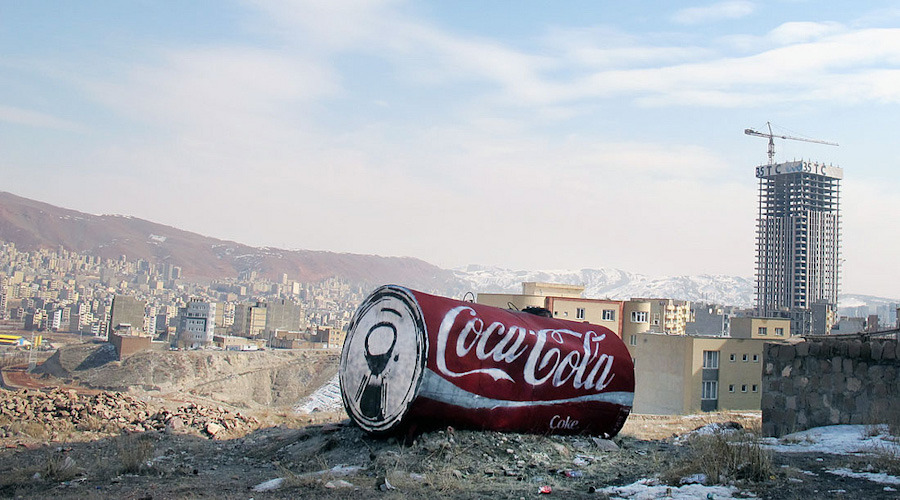
Icy and Sot, Big Can, Tabriz
          Now, it's important to say that many artists from the Middle East don't specifically reflect typical Islamic traditions.When I first brought this up to Daniela at her gallery, she immediately turned it down saying most of the Middle Eastern artists tend to lean more to western traditions, now, or are forming their own ideas. I didn't see this any place more than during my trip to Turkey, and the identity of the youth in the Middle East is changing rapidly, and I agree with an American tourist my last night there, "It's not Europe, and it's not Asia." Icy and Sot embody this idea well. They're not Banksy, but they're not your typical idea of Iran, either. Every artist needs their own distinguished hand, and Icy and Sot have found this not by so much criticizing the government in Iran we so much think about, but by giving a voice to the youth culture that's there and recognizes itself as different yet modern. The two brothers from Tabriz, Iran, make work that varies between the light-hearted and humorous skating culture, to the more serious, conceptually-rigorous work that comments on child abuse and child neglect during either war or political strife.

         When flipping through the TIMES 100 last month, hoping to find Ai Weiwei's name, I saw Ali Khameini instead. At first put off that my only choice wasn't there, I was interested to see this small section among the list. In the supporting article, I was most interested in the connections between the Iran of today and the similarities to that of China during Mao. Are the notoriety and generation of ideas of Ai Weiwei and Cai Guo-Qiang a signal for what's to come from Iran in the future, or is it already here? Has the idea of government become similar to a guarding veil, where art and ideas pass through it with ease due to the Internet? And if it is, is this conglomeration if ideas speeding towards an assimilation of identity and culture where we all feed from the same sources, or does it reach a precipice and by human nature demand us to turn back on ourselves? 

         I think, in self-preservation, we'll turn back on ourselves, but with such powerful collective thoughts be able to recognize those past threats continually pointing daggers at us. 

Monday, April 23, 2012

A city of art and history, or history and its art?


                     A friend showed me this picture the other day, taken during a walk around Angers. To say I was thrilled would have been an understatement. I had not yet seen any good street art for the past three months of my stay, and to see this yarn bomb sprout up - as well as being such a brash display of it in the city park, I immediately had to go check it out for myself.

                   The bike ride was faster than normally, happy I'd finally see some new yarn since seeing Olek's in Chelsea during January. Unfortunately, the fears I expressed to my friend, and the reason for my haste, had already been realized. The park was its normal, finely-manicured self - no urban, Liberace lion to be found. The ride back, with wind in my face and mounting thoughts about the governing French culture in my head, was a bit more difficult. I questioned my thoughts and wondered if my friend had only just now uploaded photos taken awhile back, allowing the lion its proper lifespan of short-lived street art. No, she had taken the picture within only the past three hours. 

                   Unsurprisingly, I wasn't mad. To get mad about the removal of street art, ephemerality being one component of its core, would be pointless - even more so to write about it. However, it did solidify some thoughts I had about Paris, and the idea of culture in France, since my stay here. Paris, and always France with it, has been living in the past when it comes to art.

                   To be sure, this isn't a terrible thing at all - it's what we love and come to Paris for, and there's still much to learn between Rousseau and Redon. Even more, artists like JR, Invader, and Xavier Veilhan (artists who could be considered pioneers of the much-blogged about New Aesthetic), churn out great art for the world to consume.

                  But, that's just it - it's the world consuming France, with mostly China being the primary recipient (Chateau Latour, the fabled Bordeaux vinyard, even left the historic en primeur system of selling wine futures, in order to more easily cater to the growing Chinese middle-class - effectively cutting out the middle man). This is true for many cultural sectors of post-developed nations, their artists and other cultural products being primarily admired and bought by members of the BRIC bloc. A talk with Liam Porisse at the opening of his joint show with his brother Julien at BLAST gallery on Rue Matignon - one of the only forward-thinking galleries on the historical art street, proves this point. Having studios in both Sao Paulo and Paris, M. Porisse quickly added in the conversation that so much more money is being used to buy, and more importantly promote, new,emerging art in Brasil. Also, as it stands, Singapore is poised to overtake France in amount of art bought this year, with China leading all countries since 2008.

                 This should come as no surprise. With exigeant austerity measures all over Europe and down grades landing on many western counties, it's difficult for anyone under such pressures to promote their cultural institutions. Still, it is the mindset of many in these nations that is the bane for their present day depreciation.

                 The quick removal of the yarn-covered lion draws many parallels to French denunciation of artists in the past, à la Salon des Réfuses, or the ridicule of Millet - now one of France's most revered painters. This is nothing new, but it begs me to wonder if this city, Angers, holds up to its proclamation of being one of Art and History, or just History and its Art. Much of France, like Paris, has succumbed to only promoting and commercializing the idea of its romantic past, as best given example by the magasin-lined rues of Montmartre  and Saint-Germain-des-Prés. The once movable feast has been remade into a high-priced buffet, catering its past delicacies to foreigners. This continues into almost all of the western world, not singular unto France.

                  For solutions, it is my belief that these catered visitors are just as receptive to the New, if only a risk was taken to promote it. Foreigners, while in their home nations, especially those of the BRIC nations, consume massive amounts of new culture; they are already predisposed to appreciating it. It is the mindset in these countries to want something new, and to better their lives and their standard of living. Secondly, it is imperative that these struggling economies look outside their borders for emerging talent. Nationalism is a pride to be taken seriously, but isolationism can not be tolerated in today's climate - this is especially true for the cultural institutions of economically repressed nations. Antonio Manfredi looked outside the borders of Italy for funding and aid, but only to Germany. To send a real signal to his indifferent Italian superiors, the Italian could look to more distant and striking venues - he said his staff were ready to vacate, regardless. Many galleries have already taken these risks in promoting not just themselves in new areas of the world, but also work from new areas to their home nations. This has been met with great success, and I believe there is hope on the horizon. 

               Just within these past two weeks, the Palais de Tokyo has reopened in Paris after ten months of renovation, with the full $26 million in costs being supplied by the government through the Ministry of Culture. With opening festivities that might have made Jerry Saltz hop back across the pond, the Palais is a great sign for contemporary art in France. That is, if only the rest of France really knew about it. My French roommate - thankfully an artist - supported my belief that only those French who participated in the arts really knew about it. Sadly, the number of such has been slowly dwindling as given evidence from the Christie's closure of its Paris school in 2007

               The Palais is on the right path, though, and has been since its founding 2002. So, director M. de Loisy's success won't rely on how nimbly he navigates the line of introducing new, sometimes provocative art under political gaze, but how he exposes and draws attention to the museum outside its typical audience - the already interested art world. As the Minister of Culture, M. Frédéric Mitterand, hinted at during the museum's opening of it [the Palais] needing outside sponsorship to meet its annual budget of €13m - half funded by the government, there's really no better place to look for such support than those countries so interested in the culture already there. Qatar might be interested, unless they already feels biased towards their investments in the City of London.

               Still, France has the capability of returning to the stature it once had as the heart of the 19th century. However, to do this it will need help from those outside the Eurozone - much like it did with that great Lost Generation of expats who called Paris home - to again become that fierce lion of the art world. 


Photo courtesy of Diane Megan
                   

Friday, April 20, 2012

cartewheel

The French call a map une carte, which could easily be inferred from the job title of cartographer. 

Like a map, the aim of Cartewheel is to chart and report on changes in the art world. Where do places intersect and separate, or how is it all interrelated? Nicolas Bourriaud propelled this movement with his idea of Altermodern at the 2009 Tate Triennial. However, these ideas are all reactive in their approach, much like charting a map is. It's a belief that through present technology, it no longer has to be this way. 

It's time for more proactive and anticipatory thinking. With the idea of tying together myriad sources and ideas ranging from art history to present-day geopolitics, and incorporating blossoming ideas such as New Aesthetics, we can better anticipate what the Art World of tomorrow might be like, and more importantly - make it more conducive to artists. 

There has been a continuous democratic failure in the art world, and with it art history, since before the times of Vasari or Winckelmann. However, much like a cartographer, we have the ability to define the world in its most true terms - centered around the artist and those of creativity, and away from dated practices of just the elite patronizing the arts and the ever-increasing, present day belief of art as a liquid asset.