Why make so much of fragmentary blue In here and there a bird, or butterfly, Or flower, or wearing-stone, or open eye, When heaven presents in sheets the solid hue? Since earth is earth, perhaps, not heaven (as yet)-- Though some savants make earth include the sky; And blue so far above us comes so high, It only gives our wish for blue a whet.
-Robert Frost Fragmentary Blue
|
Cerulean blue.
That has been my favorite color since an immaculate memory recalls the first day in kindergarten that I came across the color. It was one of those Crayola markers, the thin kind with a fine(r) tip, and it left such a wondrous curve and mark on the page. I had to know its name, where, at the bottom part of the marker -- in just as fine a typeface as the mark it left -- it spelled out Cerulean Blue. Pokémon would introduce me to Cerulean City, and The Devil Wears Prada would leave a remarkably scathing comment in discussion over the blue. I never hesitate when someone asks me my favorite color.
- The Color Blue -
Through André Broca's paradox, 'to see a blue light, one must not look directly at it,' we must imagine blue as being our liminal boundary, the portal between what is and what isn't, the infinite and the definite. When we are born, in such dark conditions and following Purkinje's law, blue prevails over other colors in dimly lit conditions, and is the first within the entire chromatic spectrum to be taken in. Under such conditions, one perceives the color blue through the rods of the retina's periphery (the serrated margin), while the central element containing the cones (the fovea) fixes the object's image and identifies its form. However, the fovea is the part of the eye that develops the latest, approximately 12 to 16 months after birth, leaving a total obliteration of object identification, or, more precisely, that blue is on the peripheral of or beyond an object's fixed form; that it is the zone where phenomenal identity vanishes. As Julia Kristeva goes on to state:
"This most likely indicates that centered vision--the identification of objects, including one's own self (the 'self' perceived at the mirror stage between the sixth and eighteenth month) comes into play after color perception ... Thus all colors, but blue in particular, would have a non-centered or de-centering effect ... lessening phenomenal identification ... returning the subject to the archaic moment before the fixed, specular "I," but while in the process of becoming this 'I'."Blue is the in-between, from this side to the other. It is the color of purgatory: reaching at the coming light, but drawing its identity from darkness. It is the color that, as humans, we are able to reflect on our in-betweenness, and separate ourselves from both the spiritual and the physical -- the ability to find the humane.
***
 |
| Ming Vase |
 |
| Pablo Picasso "Poor Family" 1902 |
Sent into depression over the suicide of his close friend, Casagemas, Picasso labored under the color for two years in Montmartre, painting some of his most well known pieces, and reflecting on the possibility that he, Picasso, may have been the reason his friend had met such an end. This was due to Casagemas' love for a girl, who, over time, favored him less and favored Picasso more. Then, of course, we have of the last century an entire new color being fashioned by artists, blending new technology, this instance being synthetic ultramarine, by the late French artist, Yves Klein. Klein went so far as to patent his 'cosmic' International Klein Blue (IKB) and it aids in making Klein's oeuvre one of the most distinguishable of any from the 20th century. However, when I think to Blue and its importance for artists, the continuance of art history, and most importantly its relevance to Steve McQueen, I think to Giotto.
 |
| Yves Klein, IKB |
- Giotto -
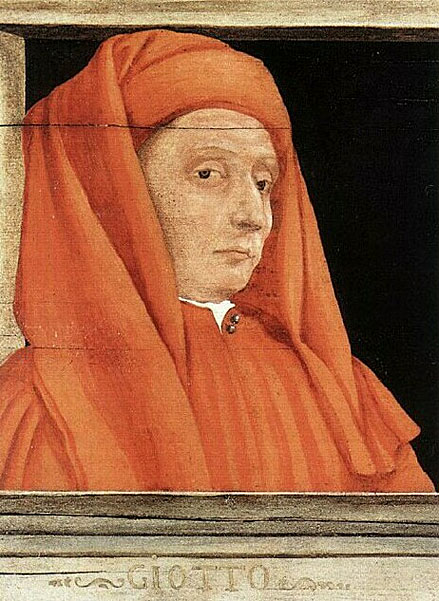 |
| Paolo Uccello, Portrat of Giotto c. 1305 |
 |
| Giotto Arena Chapel |
However, unlike other painters before him, even his teacher Cimabue, Giotto initiated a break from the higher spheres of spirituality and the dominant modes of painting prevalent at the time. As Matisse would later comment on the meaning and expression of color in painting, that is painting's "fundamental" device, and their necessity for revolutions in the plastic arts to come about he would also remark on Giotto's exploration away from the Church:
"When the means of expression have become so refined, so attenuated that their power of expression wears thin, it is necessary to return to the essential principles which made human language ... 'going back to the source' ... Pictures which have become refinements, subtle gradations, dissolutions without energy, call for beautiful blues, reds, and yellows -- matters to stir the sensual depths in men."
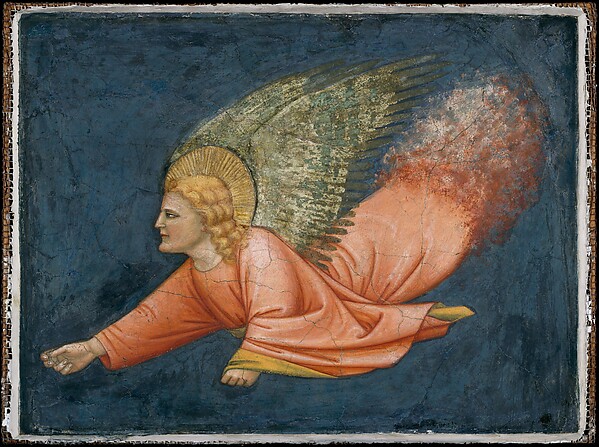 |
| Two Angels North Italian Painter First Quarter, 14th C. Metropolitan Museum of Art |
spiritual leaders voicing distrust in the new style of painting - which began to be perceived as 'not elevated enough" spiritually, if not simply "burlesque." Walking through any museum, one can immediately note that, as the rooms transition between ages and one walks through the portals of different epochs, there is a radical change in color and style beginning from the early quarter of the 14th century and on-wards to the High Renaissance (img). Giotto, with the color blue, was the departure for this style and gave precedence to artists later on, moving away from the spiritual, to the natural of so-called 'burlesque' as Hegel evinces in The Philosophy of Fine Arts:
"Giotto, along with the changes he effected in respect to modes of conception and composition, brought about a reform in the art of preparing colours [ . . . ] The things of the world receive a stage and a wider opportunity for expression; this is illustrated by the way Giotto, under the influence of his age, found room for burlesque with so much that was pathetic [ . . . ] in this tendency of Giotto to humanize and towards realism he never really, as a rule, advances beyond a comparatively subordinate stage in the process. . . "
- Steve McQueen -
Giotto was of course a part of the standard curriculum in the art history program at university, and I even researched his architectural pursuits, which the Arena Chapel and Il Duomo's campanile in Florence fall under. Yet, his importance in the shift between Early to High were much left out.
 |
| McQueen |
However, this British film director, who has no more than 10 short and featured works total, has won the Turner prize (the same year Tracey Emin's Bed gained so much publicity), the Camera d'Or from Cannes for a first time director -- the first British director to achieve such -- and been nominated for a Golden Lion at the Venice Film Festival.
 |
| Hunger |
I'm not reluctant to say that I actually stole the copy I found--knowing I'd never find it anywhere else when I returned to the states, and only having a few euros left on me. I'd read of the uproar and fuss so many had made about the movie, and McQueen's criticism of the Academy for not nominating Fassbender for Best Actor -- a valid criticism, although [Jean] Dujardin was destined to win. So, why the uproar?
 |
| Shame |
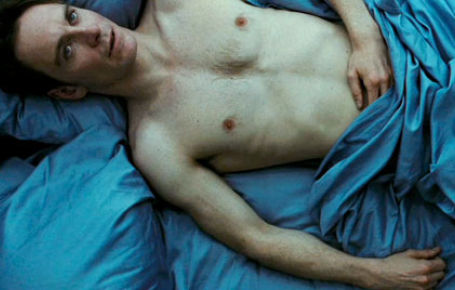
It would be easy to stop at the comparisons and balances between the concepts of humanity, Michael Fassbender's roles, and intensely graphic situations shared between the two movies. However, while watching Hunger, I was struck by an odd atmosphere which persisted in McQueen's work and which most reminded me of Shame: the color Blue.
 I'd be remiss if I wasn't reminded of this satirical Venn diagram when I first saw the re-occurrence(s) of the color, so I did some quick initial research to find if anything had been written
about McQueen and the color. Not surprisingly, there hadn't; however, what strengthened my opinion on McQueen's affinity to blue and my desire to flesh out such a connection was something I had never hear of. It was an unfortunate blow to my art ego's pseudo-belief of knowing what happens at every large cultural institution.
-Vondelpark -
 |
| Vondelpark at Night Regular lights |
 |
| McQueen's Blues Before Sunrise |
Although I can not comment on the atmosphere in Vondelpark during the project, there is actual meaning and a sensory experience that McQueen wanted visitors to feel in the early morning hours. The park project is titular to a Blues staple, Blues Before Sunrise, originally performed by Leroy Carr and Scrapper Blackwell, and successively by Ray Charles, Count Basie, and other Jazz or Blues pianists who took influence from Carr.
Carr, born in Tennessee and who spent most of his life in Indianapolis, actually preceded the more-mythical Robert Johnson in recordings, but it was Johnson's more fierce, raw and ultimately unrefined style that drew favor away from Carr who played in smooth melodies and a clear, expressive voice. This is much due to Rock n' Roll's, as well as today's, desire that the Blues be as primitive and back country as perceivable. So too is it the reason why we prefer our Blues clubs as dirty, low-run and off-the-beaten path as possible. It all adds to the authenticity of what we've perceived as the Blues. However, what Carr carries better than most Blues musicians, and the inspiration for McQueen's early morning park project, is his haunting vocal presence.
The soul of the Vondelpark piece, McQueen said, came from that haunting presence that the Blues and Carr's piece offer (it's also possible that McQueen used such a description from Elijah Wald's essay on Carr), and it's McQueen's atypical selection and consideration of Blues music that too translates to his unconventional use of the Blues as a color.
- Blues in Shame and Hunger -
It is impossible to discuss color and light today without thinking of James Turrell--making tidal waves in the art world at present with three contemporaneous retrospectives happening across the country in different museums-- and so it is impossible to discuss the color Blue not solely as a pacifying, majority-favored hue and shade, but as an actual thing. Or, to misappropriate Turrell's words, the Thingness of Blue. How do we understand Blue and its relation to us--its effects on society, and how do we understand McQueen's atypical usage of the color? So often in his work, where the characters are tormented by their choices and occupations, his choice of the color highlights that theme of shared humanity--even as so much guilt is cast on their actions-- between the characters.
Considering what we have said about Giotto, the liminal pursuit of Blue, and its disassociation from norms and conventions, we could now safely approach McQueen's employment of the color as if it were more than just a setting, but an actual component or character of his work.
Thinking to Hunger, and the idea of Blue relating two opposing or disproportionate characters, there is a relationship between Lohan (Stuart Graham), the detention officer at the gaol, and Sands (Michael Fassbender). The movie starts off with Lohan, leaving for work--a good man by all accounts--saying goodbye to his wife for the morning, and checking under his car for any bombs or suspicious leads around his home. It's a while before we actually meet Sands and the movie takes up its central plot, but for the time we follow Lohan, there is a blue haze centered around his
 |
| Lohan (Graham) |
 |
| Sands (Fassbender) and Father Dom (Cunningham) |
 |
| Brandon (Fassbender) Sissy (Mulligan) |
For Shame, McQueen amplifies the use of that vehicle, transitioning and drawing associations between characters, while also skewing or questioning perceptions of particular taboo subjects (sexual addiction, incest, pornography, infidelity, masculine insecurities, etc . . . ). As physical objects: the sheets of Brandon's bed, his dress shirt, his scarf, and again that haze of blue in late night runs or early morning revelations, all draw the humanity out of his character and blur out guilt. Both Sands and Brandon are the antihero of their respective dramas, and made heroes only through the humanity that they seek to find -- exemplified in the atmosphere and the objects which adorn them.
Where Brandon's sexual addiction runs rampant, between online sex and pornography to bisexuality and a menagé trois, his desire to rid himself of such vices and deteriorates reflects upon the viewer and their own desire to be rid of vices. In making Shame, McQueen and co-writer Abi Morgan interviewed different sex addicts, interestingly finding more vocal addicts in New York (where the movie was eventually shot) than in their home of London. Having equitable comparison to drug or alcohol addiction, sex addicts often describe 'one as too many, a thousand not enough,' and overcoming sexual addiction, much like any addiction, means coming to terms with both past and present stressors, as well as societal pressures. In Shame, Brandon's stressors are magnified when his sister, Sissy (Carey Mulligan), comes to live, not stay, with him extempore. Brandon's entire, meticulously-designed lifestyle is interrupted, and, although he fights his addiction, is thrust deeper into it by her arrival.
 |
| Brandon and Sissy |
Colors change as Brandon succumbs and overcomes, his revelation and climax -- possibly a legitimate climax as critics wondered if the hooker sex scene was real -- moving from an intensely lit, bright scene into one of the darkest yet as he wonders if his sister may have finally committed suicide. Earlier in the movie Sissy teases by leaning over the edge of the subway tracks, worrying her brother. Exiting his orgy, he finds the subway is closed because of an emergency and isn't able to get in touch with Sissy through her mobile.
From lightness--the intense, grief-induced sex scene--to darkness and Sissy's attempted suicide, there is a continuous doubt of right and wrong. We can of course say that we know right or wrong, but as we reflect on our own rights and wrongs, we are able to empathize with Brandon and Sissy. McQueen gets at this empathy through a striking resemblance of the viewers' own questions, disobedience, and personal taboos. Essentially, he is able to connect such addiction and conviction, in both Brandon and Sands, respectively, to the viewer's own vices and desires.
Right and wrong are blurred in McQueen's films, and instead we are directed to look at the characters from an oblique perspective. We look past their initial, surface actions, and from our periphery, as the blue filters in and decentralizes the characters lives and narratives, we are able to really see the characters as they are and relate to us. Human and natural.
***
I began this essay with a poem by Robert Frost, where he asks in a hurried verse: why do we strive to contain and make physical this omnipresent color with all its associations? We of course have a need to attach and label anything we come across, the need to critique it, the need to make it understood on such a basic level. This is all the need to consume.
What is most telling about the color blue is that, even while it has been sought and implemented through myriad of cultures, it still escapes our focus; it still escapes our desire to control it. Only is it when we do not search for it does it present itself in sheets the solid hue, and then does it bind us together, between us as humans, rather than us binding it unto our selves.
*- being such, the minarets as Mecca now count seven, as was ordered by Sultan Ahmed at his camii's (mosque and kulliye complex) completion.